LadyLead Magazine Interview
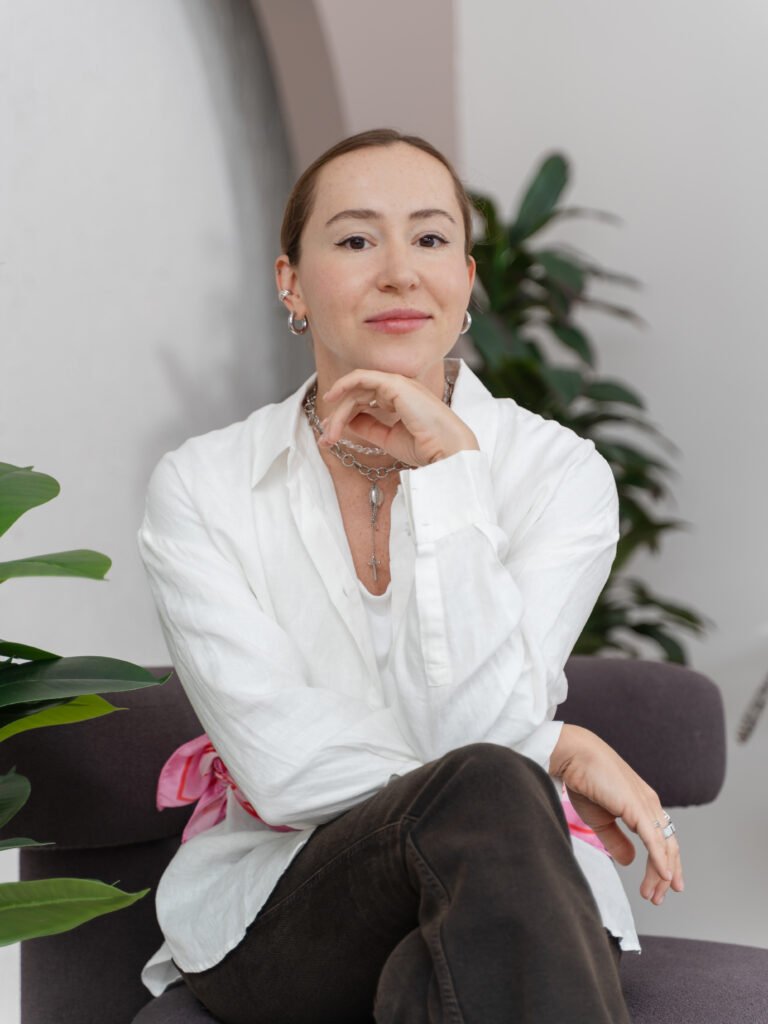
LadyLead: Irina, your journey from social media manager to Brand Director is quite remarkable. Looking back, how has that evolution shaped the way you lead today, particularly when it comes to managing and inspiring a diverse team of more than 40 specialists?
Irina: My path from social media manager to Brand Director has been defined by working at the intersection of psychology and marketing. Early on, I realised that strategy that works isn’t just about data, rather about understanding the human element. That applies to our teams just as much as our customers.
A big challenge for me was learning to balance personal emotion with business objectives. There’s a misconception in the corporate world that empathy signals weakness, but I see it as a real advantage. When people feel valued, they don’t just show up – they perform.
Managing a diverse team of over 40 specialists, I focus on building a culture of trust, flexibility, and growth. We’re all about finding talent and giving them room to grow. Sometimes giving someone space to explore beyond their role unlocks a new level of creativity.
My leadership style is about combining empathy with business goals. I believe real success comes from a team that feels empowered, connected, and seen.
LadyLead: That balance between people and performance seems to be a strong part of your leadership philosophy. And that same balance must become even more important when you’re building a brand across such a wide and diverse geography. Udora now operates across more than 50 countries. What has that journey looked like, particularly through the rebranding from Flowwow to Udora?
Irina: Flowwow now became Udora as a part of our 2024 rebranding strategy. The real challenge during the rebrand was to preserve our core identity and keep what made the brand recognisable and trusted, while still making the new look relevant and understandable across 50+ different markets.
With such a wide geography, there always should be a balance between consistency and localisation. Too much localisation can dilute the brand and make it feel fragmented, while too little can make you look disconnected from the local culture.
To get this right, we built a solid brand platform that clearly defines our mission, brand idea, tone of voice, goals, and personality. Based on this foundation, we then branch out into country-specific communication strategies. We look at everything from local cultural nuances and gifting behaviours to key occasions, public holidays, and how we stand out against local competitors.
On the design front, we introduced a more flexible visual system, including an extended colour palette that allows regional accents. For example, we use deeper greens and gold tones for the UAE, while brighter and more vibrant colours are used for Spain.
We also developed localised photography guidelines that reflect cultural norms, such as more expressive and emotional imagery in Spain, with a focus on ‘La Vida Buena’, and more restrained, elegant visuals in the UAE.
All of these adaptations are reviewed with local consultants to ensure cultural accuracy while protecting overall brand consistency.
LadyLead: You mentioned the importance of understanding people and culture, and that naturally brings us to another subject that is very close to the heart of LadyLead: women and empowerment. With such a large female presence within your team, how do you personally approach creating an environment where women can grow, lead and feel confident in their ideas?
Irina: A large part of our team is female, so for me, creating an environment where they can grow and feel confident is very important. My approach is quite simple: I believe in giving people real responsibility and the backing to run with their own ideas. I am trying to build a culture where taking the initiative is celebrated and where every voice is heard.
At the brand level, women empowerment is reflected in everything we do. We feature our female team members in brand storytelling, share the stories of women entrepreneurs and sellers on our platform, and involve them in content creation.
It’s important for us to show real, diverse women without stereotypes. We want to celebrate different backgrounds, unique ambitions, and experiences in a way that feels authentic.
For me, women empowerment is not a separate initiative, it is a part of the daily reality of how we operate as a brand and a team. It’s just how we do things.
LadyLead: Authenticity is clearly important to you, both in the way you lead people and in the way the brand communicates. At the same time, marketing today is increasingly driven by numbers and measurable performance. How do you make sure creativity and business results work hand in hand?
Irina: We always start with clear goals and KPIs. If we can’t answer what business objective a campaign is solving, we simply don’t launch it.
For us, creativity shouldn’t exist in a vacuum. It has to support a specific business goal. Most often, that means reach and brand awareness, website traffic and app downloads, or ultimately sales.
We work at the intersection of brand and performance, and we call this approach ‘brandformance’. The goal is to build a clear funnel from awareness to conversion.
At the same time, each channel has its own benchmark. We understand what level of reach can realistically lead to the next stage, whether that’s traffic, downloads, or sales. We continuously optimise these metrics to improve overall campaign performance.
LadyLead: Of course, not every campaign or idea delivers exactly what we expect. Sometimes the biggest lessons come from the experiences that don’t go according to plan. Was there a particular challenge that changed the way you approach marketing today?
Irina: When we were just entering the market, we were offered a placement in the first episode of what seemed like a potentially high-reach podcast. We agreed, but made a classic mistake — we hadn’t set clear KPIs for reach in advance.
As a result, the podcast didn’t quite deliver the numbers we’d hoped for, and the CPV turned out to be extremely high. It became a turning point that helped us completely rethink how we work with influencers.
First, we became much more disciplined about defining clear and realistic KPIs, so expectations are aligned and performance can be measured in a transparent way.
Second, we systematised benchmarks across channels. For example, we understand that reach on Instagram is typically more expensive than on TikTok, so we never treat them as interchangeable and always factor that into planning.
Third, we always diversify budgets across platforms to reduce risk. We remain open to experimentation, but we also distribute spend across multiple platforms to reduce risk and improve results.
In the end, that early ‘failure’ significantly improved the efficiency of our influencer marketing management and helped us optimise spend across future campaigns.
LadyLead: That is such an important lesson — especially in a fast-moving industry where experimentation is unavoidable. And when you’re building a brand that needs to speak to audiences across 50+ countries, how do you make sure your goals remain relevant both internationally and locally?
Irina: Our starting point is always the same: a brand objective isn’t worth much unless it’s measurable and linked to our business goals.
If the company has ambitious growth targets, for example, 2.5x year over year — this is automatically translated into all marketing and brand channels.
As we are now building the brand almost from scratch, we’re focusing on foundational but meaningful indicators: organic traffic growth, rise in brand searches across search engines and app stores, and overall reach across media campaigns and social channels.
One of our key goals is to position the brand as both technological and global. At the same time, we are very intentional about maintaining balance — on one hand, we communicate scale and innovation, while on the other, we remain accessible and locally relevant.
Overall, our campaign development process is structured into three stages: research, development and validation with local experts.
First is research. We analyse previous campaign performance and conduct additional research, such as in-depth interviews, to identify what can be improved and how to increase impact.
Second is development. This is where we ensure the creative isn’t just ‘art for art’s sake’. Every activity has to deliver a measurable outcome, whether that’s a spike in installs, traffic, or direct sales.
Third is validation with local experts. Given our global footprint, this is critical. We always review communications with local teams or consultants to ensure relevance, clarity, and cultural accuracy, and to avoid potential missteps.
In the end, our approach is not about choosing between global and local. It is about building a system where a strong global brand framework is enhanced by precise local adaptation.
LadyLead: After more than six years with the company, you’ve witnessed — and contributed to — a significant part of Udora’s evolution. When you look beyond KPIs and business targets, what does success actually mean to you, both personally and professionally?
Irina: For me, personal growth and the evolution of Udora are almost inextricably linked. I’ve been with the company for more than six years, and in many ways, I’ve matured alongside the brand itself.
Of course, business goals and KPIs are a huge part of success, but for me, it also goes beyond numbers. It’s about finding the right partnership, creating a campaign that people really remember, and building ideas that emotionally connect with the audience.
A big reward is also seeing Udora grow into a recognisable, trusted, and meaningful brand across different markets. As we are currently in the process of rebranding, this moment feels especially important for shaping how the brand will be perceived going forward.
We are building a product that helps people express love, care, and appreciation, so it’s important for me that customers feel happy and emotionally connected to their experience with our service.
Another important measure of success for me is the team. We spend a huge part of our lives at work, so I believe it’s vital that my team feels supported, inspired, and enjoys what they do. I always keep an eye on the team’s vibe, because a strong, inspired team is also a key part of long-term prosperity.
LadyLead: And as the marketing and technology landscape continues to change so quickly, staying ahead requires a willingness to experiment. How do you encourage your team to innovate while still protecting what already works?
Irina: For me, ‘no’ is rarely the final word – especially when the team brings a strong idea or a new tool. We are always open to testing new approaches and channels, even if they seem unconventional or risky at first.
Usually, around 70% of every marketing campaign is built on proven, high-performing tools, while the remaining 30% is dedicated to experiments and new ideas. This balance allows us to stay both effective and innovative.
This culture has been part of our brand DNA for a long time. Many of our successful channels and marketing tools originally started as employee initiatives. That’s why it’s important for me to maintain an environment where people feel comfortable bringing new ideas and taking real ownership of an idea to make it come true.
But innovation is not only about freedom, it’s also about pace. We try to launch hypotheses quickly, evaluate results fast, and scale what works.
This approach helps us stay flexible, adapt quickly, and remain competitive in a fast-moving market.
LadyLead: Finally, if you look at the journey ahead — for yourself, for your team and for Udora — what would you most like to see grow from everything you are building today?
Irina: I think what matters most is continuing to build a recognisable, trusted and meaningful global brand while keeping the human connection at the centre of what we do.
For me, success is not only about growth or numbers. It is about creating work that people remember, building teams that feel inspired and empowered, and making sure that the brand continues to connect with people in an authentic and meaningful way.